Blog

  • 9 Compelling Reasons why you should participate in Community events

    The Blog Read Out Loud

    You are going about your daily life. The routine keeps you happy and healthy. The financials are sorted. You are living the good life. Yet, something seems to be missing. Introducing, theme based community events! Community events are, as the title suggests, events scheduled for a set time around a community. For instance, if you are a member of the inking community, you can ink and think for thirty days. These help you practice your thing alongside people driven by passion around the same profession and/or hobby.

    Here are nine reasons why I think community events are the coolest things ever!

    1. Misery loves Company

    Community events involve a community. Small, medium or large, this will be a group of people who really care about doing something specific. You like writing prompt based micro fiction for thirty days straight? Fictember got you covered. Whether you know how to write micro fiction isn’t relevant. The only thing that matters is you want to do something. You won’t be miserable alone. Someone will be there to help you out, whenever you need them to. You won’t be alone.

    2. There’s strength in Numbers

    You won’t be in it all by your lonesome. Unlike the twig that snaps with a little pressure, human beings need groups, a bundle of twigs that won’t snap no matter how much you try. Community events draw out the twee-s from the entire world. These puffins get together around their passion projects and simply create. Whether it is coders coding or gamers gaming, these events do make our emotional core stronger.

    3. Creative Collaboration by Participation

    Collaboration has become a buzzword in professional media circles for a reason. It works. When you collaborate, you feed off each other’s energies. Instead of contemplating things while swimming in the miserable soup of you psyche, you can collaborate with someone. This someone will find you via these community events. They might be like you or completely unlike you. Together though, you guys could create magic. I created two books with people I found via a LinkedIn event.

    4. Building an Action driven Community

    The potatoes you find via these community events will be willing to potate with you around the niche that brought you together. You have an action driven community at your disposal for advice, support and critical appreciation. That is literally, figuratively and metaphorically amazing!

    5. Finding mentors becomes easy

    People with experience often join community events to see whether they still got it. Instead of spending hours looking for mentors, you can simply participate in such events. Collaborate to create along the way. You will definitely find people who will rise above the crowd courtesy of skills and experience. If you participated earnestly, you can simply approach them with a mentorship request. Mostly, you will get a yes!

    6. Networking of the best kind

    You can do a brute force networking attack on Social and Professional Media platforms. I would rather just do this instead – participate and vibe with the adorable fritters of any community I get involved with. This would lead to networking with intention. It will also give you an opportunity to customise your networking messaging.

    7. Constructive Feedback from people who walked the talk

    You will see three common types at these community events. It here refers to what the community event is about (writing, reading, painting, coding, building, et al.).

    1. Those who love it.
    2. Those who want to try it.
    3. Those who want to see it.

    All of these individuals will have the intention. They will also have some degree of experience. So, when they criticise your work, it will be constructive; helpful.

    8. You have fun in Groups

    Life really isn’t hard, if you’ve got some adorable snoots to bop. Things are fun when you do them in groups. The sprints that happen during NaNoWriMo are insanely productive and fun writing exercise. Why? Mostly because people sprint together and have fun on the way.

    9. Something to look forward to

    NaNoWriMo, Inktober, Huevember – these are three events I do regularly. Fictember is something I started on LinkedIn. I know these events will happen irrespective of my participation. If I am blocked creatively, these events provide ample incentive to unblock. You can give this a shot. Trust me, it is worth it.


    Let me now show you the results of my community events.

    NaNoWriMo

    NaNoWriMo is the National Novel Writing Month of November. Every year, people pledge a set amount of words and then they just get to writing. The general figure is 50,000 words in 30 days. I have done NaNoWriMo twice and I got one book out of them (which I successfully pitched to an agent). Hear my experience.

    NaNoWriMo Experience

    Fictember

    Fictember is something I started with a friend on LinkedIn. The nonfiction to fiction transition is hard for writers like me. So, I asked the community and they participated. We got together and wrote prompt based micro fiction for thirty days. It was challenging and it was fun. You can join Fictember as well.

    Inktober

    On a rather gloomy day of September in 2020, as I contemplated the upcoming doom which is Preptober (preparation of NaNoWriMo), I just felt overwhelmed. I didn’t know what I wanted to write. My personal life was a bit of a mess. My professional life was painfully normal. I was just overwhelmed. There is no better way to describe it.

    Then came the magical unicorn which survives on the tears of photoshop and crushed dreams. Instagram promoted an inking event – Inktober. Inktober is a prompt based inking challenge which runs throughout the year (Inktober52) or you can participate in it for an entire month (Inktober Classic). This is where you make one drawing per week throughout the year or you ink continuously for all the thirty one days of October. No matter what you choose, you are only allowed to use ink.

    Now I am an ambitious racoon. Instead of foraging through the forests, I always choose to dive head first into a pile of trash. I therefore chose to torture myself by preparing for NaNoWriMo November and by inking prompt based drawings for thirty-one odious days. 

    That wasn’t all. On top of the prompts for Inktober 2020, I decided to be an over-smart masochist and aspired to link all the 31 prompts to writing. To simplify, I chose to make thirty one drawings using just ink and paper. These drawings were not going to be random doodles. They were all going to follow Inktober’s assigned themes and I was going to link them all to writing.

    Inktober 2020

    I am happy to report how I succeeded. I succeeded so well, I am going to do the same for Inktober 2021.


    You are probably wondering why I am telling you this! It’s simple – I just want you to know how trying different things that seem like torture could actually turn out to be the thing that brings you peace. In the extremely busy, chaotic lives most of us lead these days, we often forget that us humans, we are not born with a manual. We are blank slates. We figure things out as we go along the path of life. If you don’t try the thing due to any excuse, well, you’re missing out.

    Also, I wanted to brag a little. The sentiment being, “Oh look what I did!” This pompous puffin who couldn’t draw a straight line used outrageously expensive ink and some weirdly angled ink pen to ink writing theme doodles for an entire month while working, studying and going through life as is. If this lazy cat can do it, so could you.

    Fun fact: This is my first ever blog. I have never written about personal experiences because I thought personal is, well, personal. Going by that lovely logic, I have been sitting on so many personal stories of joy, sorrow and extreme mundanity, I could talk your ears off. Who knows, maybe I will!

    If you want to know whether I become someone who overshares in the upcoming future, sign up for my newsletter using the link below. Also, let me know what you want me to try next!

    The Writing Catalogue

    All content on this website, including blog posts, writing samples, and service descriptions, is the intellectual property of Binati Sheth and is protected by copyright law. Do not quote, reproduce, copy, or republish any part of this content without prior written permission. Unauthorized use is strictly prohibited and may result in legal action. For permissions or inquiries, please contact: [email protected]

  • Increase your productivity with Andrew Grove’s High Output Management

    Increase your productivity with Andrew Grove’s High Output Management

    Andrew Grove’s High output Management is not a book; it is more of a textbook. So a disclaimer on my part, read the book as if it is a textbook. Another disclaimer will have to be this: while the book will benefit managers and industry leaders the most, freelancers and entrepreneurs can also employ the input-output strategy Mr. Grove recommends.

    Audio recording of the blog read out loud

    Andrew Grove’s High output Management is not a book; it is more of a textbook. So a disclaimer on my part, read the book as if it is a textbook. Another disclaimer will have to be this: while the book will benefit managers and industry leaders the most, freelancers and entrepreneurs can also employ the input-output strategy Mr. Grove recommends.

    The book offers Experience + Knowledge + Learning + Unlearning.

    The three main things you learn:

    1. Every single person within an organisation has some output (which can be optimised).
    2. Managers are like micro-CEOs. Their overall output is equal to the team’s output (leverage the output).
    3. Everyone should chase peak performance (and how a manager’s peak performance inspires the team’s peak performance).

    He also goes into the communication system employed by Intel Corp (when he was in charge of it).

    Part 1 of the explanation (because at the 1 hour 6 minute mark, my live crashed 😢)
    Part 2 of the explanation (because when lives crash, we apologise like normal humans with action😊)

    If you want to read Andrew Grove’s High output Management, you can:

    1. Visit your local library.
    2. Borrow the book from a friend.
    3. Grab a free audiobook from audible (which gives one book for free once you sign up).
    4. Buy the book from a local bookshop (support small businesses).
    5. Buy the book from Amazon.

    Now, let us get into the book summary of Andrew Grove’s High output Management, shall we:

    Part I – The Breakfast Factory

    Chapter 1: The Basics of Production: Delivering a Breakfast (or a College Graduate, or a Compiler, or a Convicted Criminal)

    Know your work

    An employee should know their own work. They should know what their own output is. This is where you draw your entire workflow with an expected output and an actual output. If you can make this diagram easily, chances are your workflow is optimised to suit you. If not, know your work well.

    Chapter 2: Managing the Breakfast Factory

    Execution

    Understand with clarity who you are and what you do without all the weasel language. Weasel language is the language you use to justify things unnecessarily. Then, make an execution strategy. Begin by identifying the indicators in your group output. See the quality and quantity of output. Notice your most important indicators regularly and set goals accordingly. Keep doing this and you’ll be able to predict your job performance. Keep simplifying your workflow (make it as linear as possible) as you do this activity repeatedly.

    Part II – Management Is A Team Game

    Chapter 3: Managerial Leverage

    Leverage

    Time is the most valued asset. Individual contributions generally have a low leverage. Activities like coaching and teaching have high leverage. Ideally, you want to increase high leverage activities. Make a plan accordingly.

    Chapter 4: Meetings—The Medium of Managerial Work

    Meetings

    No matter how much we hate them, meetings are important. Mostly upper management needs meetings to see how stuff tends to work on the floor. Lower management needs them to gauge their understanding of the work. Depending on the type of the meeting, you have to have a set mind frame.

    Chapter 5: Decisions, Decisions

    Decisions

    You should make decisions with all the information. To have all the information, have free discussion, then go to clear decisions (people won’t be on the same page), finally have full support discussions (to enhance inclusion). Make these decision-based discussions a loop. Communication skills come in play massively here.

    While making decisions, remember to prioritise the deadlines. Mention all the people to be included in a decision (who decides, who consults, who’ll be informed, who can override, who can make authority-based changes).

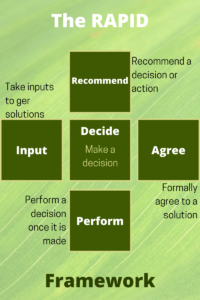
    Also, try the RAPID framework for decision making:

    Input + Recommend + Agree + Decide = Decision

    This is a RAPID framework graphic

    While doing all of this, remember that making decisions is hard. So, give people some space.

    Chapter 6: Planning: Today’s Actions for Tomorrow’s Output

    Planning

    You have to ask yourself this question: What should you do today, to avoid problems tomorrow? Based on your answer, you should analyse and evaluate your present while focusing on your organisational capacity. Then you should think about the future and maybe forecast things. Finally, reconcile the present with the future.

    Make a plan. Strategize and execute according to that plan because existing resources will be utilised by the activities of the present and therefore they might dominate the decision-making process.

    Also, Mr. Grove recommends this: define three important tasks for your organisation and defend them with proper discussions.

    Part III – Team Of Teams

    Chapter 7: The Breakfast Factory Goes National

    Scaling

    Every business plans to scale up. If you are someone with a product and a team, you can scale up. Before you try scaling, you have to have the centralisation versus decentralisation discussion. Then, you need to plan. Finally, set your system and expectations, and begin scaling.

    Chapter 8: Hybrid Organisations

    Centralised versus Decentralised versus the Best of Both Worlds

    You have three choices. See your organisation structure and reorganise accordingly. They are:

    • Decentralised systems: They offer fast execution of tasks which enable super quick decisions. Resources can be used easily. Each individual is independent of the organisation. All of this can make these structures expensive. Given their flexible nature, an employee can explore employment options throughout the entire organisation.
    • Centralised systems: They offer high specialisation, expertise and leverage. On account of the expertise involved, lengthy negotiations are a common phenomenon making these systems slow to respond.
    • Hybrid systems: You analyse your organisation. You mix and match the aspects of centralisation and decentralisation.

    Chapter 9: Dual Reporting

    This phenomenon shows up the larger the company is. When dual reporting presents itself, you can go:

    1. Function oriented (focus of the execution; the how)
    2. Mission oriented (focus on the project)

    No matter what approach you follow, remember to work with the problem solvers. Flexibility will be key, followed closely by communication. As you are working with multiple teams, clarify what is expected from everyone you’re working with.

    Chapter 10: Modes of Control

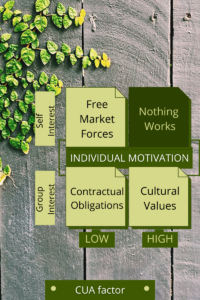
    There are three modes of control that tend to affect an organisation. They are:

    1. Free market forces (based on personal choices) 
    2. Contractual obligations (the law) 
    3. Cultural values (what makes us human)

    Mr. Grove further classifies these into VUCA which is volatility, uncertainty, ambiguity, complexity. As volatility is something we cannot control, all you can do is calculate your organisation’s CUA factor to stay in control.

    This graphic shows the free market forces and the CUA factor.
    CUA factor

    He stresses upon remembering how you need cultural values to make your organisation adjust to change. Cultural values also enable you to improve people’s trust.

    Part IV – The Players

    Chapter 11: The Sports Analogy

    Training + Motivation

    Super athletes are highly motivated to perform irrespective of the circumstances. To have employees who are self actualised, you have to provide them with proper training and motivation. You have to find gaps in everyone’s situation and address them by proper training or coaching.

    Also, remember that once someone achieves what they set out to do, their motivation will drop. To avoid that, find out what keeps their motor running. Self-actualised people just keep going.

    Chapter 12: Task-Relevant Maturity

    It is shortened to TRM. There are four steps to maturity:

    1. Directing 
    2. Coaching 
    3. Supporting 
    4. Delegating

    Everyone is different so try task relevant maturity. For people with low TRM, offer full support. Most individuals will have medium TRM. Observe where they need support and provide it. Very few individuals within each organisation have high TRM. Offer minimal support to these highly actualised people but you need to closely monitor them.

    Chapter 13: Performance Appraisal: Manager as Judge and Jury

    Performance Reviews

    Performance reviews are super important.

    When you offer performance reviews, avoid these:

    1. Any surprises.
    2. Not giving any improvement suggestions. 
    3. Sending mixed messages. 
    4. Feedback which is too general. 
    5. Only commenting on recent work. 

    When you offer performance reviews, definitely practice these:

    1. Be honest with praise and criticism. 
    2. Prepare in advance. 
    3. Watch your body language and observe their body language (adjust your response accordingly). 
    4. Check whether the message is heard. 
    5. Focus on suggestions.

    Andrew Grove tells us to focus on the star performers by giving them the most comprehensive performance reviews.

    Chapter 14: Two Difficult Tasks

    Interviewing and retaining people

    Interviewing people is hard. Even if someone aces all the aspects of an interview like:

    1. Skill questions 
    2. Achievements/failures 
    3. Strengths/Weaknesses 
    4. What values should we hire you for

    … this employee can fail. To avoid falling into this trap, check for skill gaps. See what they did with their knowledge. Notice any of the discrepancies to see how they learned from past mistakes.

    Retaining employees is also important. To retain good employees, collaborate with the supervisor. If someone says, ‘I quit’, that is a bad indicator. This will cause a cascading effect of resignations.

    Chapter 15: Compensation as Task-Relevant Feedback

    Salary

    Salary is used to anchor performance. You need to compensate your employees accordingly.

    Chapter 16: Why Training Is the Boss’s Job

    Training

    You should hire a proper trainer. Do not cheap out.


    This is a wrap on Andrew Grove’s High output Management. You should definitely read this book.

    Happy Reading!

    While you’re at it, subscribe to the newsletter.

    The Writing Catalogue

    All content on this website, including blog posts, writing samples, and service descriptions, is the intellectual property of Binati Sheth and is protected by copyright law. Do not quote, reproduce, copy, or republish any part of this content without prior written permission. Unauthorized use is strictly prohibited and may result in legal action. For permissions or inquiries, please contact: [email protected]